How AI finally becomes a true business partner thanks to MCP
Most companies today use AI rather as a prototype – it’s good for chatting or analytics, but it’s never really connected to live systems. MCP changes that by working as a universal interface which allows AI agents to fetch, transform, and use business data in real time via a single, secure protocol.
Getting rid of custom integrations is the first step
Before MCP, connecting an AI model to each data source required special coding and every upgrade meant a ton of maintenance. With Model Context Protocol, AI agents simply “speak the same language” as your systems, cutting integration complexity by up to 75% and enabling AI to scale without the need for a dedicated integration team.
How MCP works under the hood
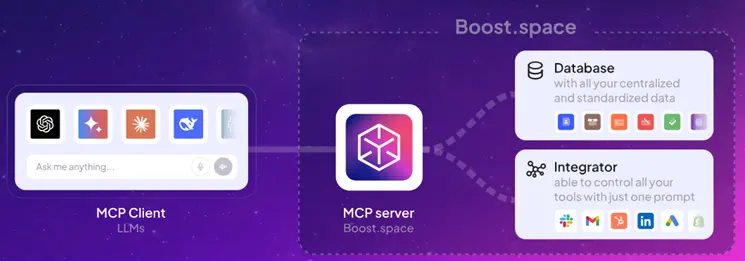
MCP uses a client-server model, where AI platforms include a lightweight client library that communicates with an MCP server in the cloud. The client manages authentication, request retries, and streaming data. It offers three simple methods – invokeTool(), fetchResource(), applyPrompt(). The MCP server then exposes your API, databases and automations through standardized JSON-RPC 2.0 endpoints.
Three built-in elements unlock AI automation
– Tools allow AI to perform actions such as creating CRM records or sending notifications.
– Resources provide up-to-date data – for example inventory levels or number of tickets in support.
– Prompts guide AI through best-practice templates for common business tasks.
This framework brings more than a basic function call – it forms an action layer where AI moves seamlessly from insight to action, all in your organization’s secure environment.
Sample MCP use cases
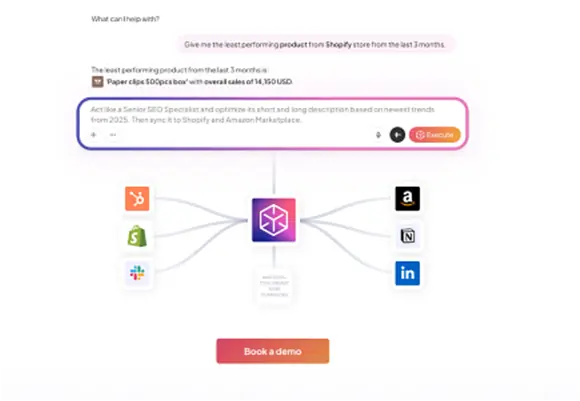
A sales team can ask “How many deals closed yesterday and which need follow-up?” and AI delivers an accurate result from current data. An e-commerce manager can say “Lower the prices of non-selling products by 10% and launch an email campaign” and see the system actually execute that across platforms. Support can command “Create a summary of unresolved tickets by priority and assign to the best engineers” – all through natural language.
That’s why Boost.space stepped up first
Boost.space MCP brings this standard to life through a ready-made server solution and global integration network. The MCP server runs on the three-way synchronization engine of Boost.space, connecting over 2,486 apps and resolving data conflicts for a reliable single source of truth. That means AI always works with clean, unified data.
The results speak for themselves: companies that implement MCP see 20–30% boosts in process efficiency, roughly a third fewer data errors, and implementation times halved compared to traditional approaches.
Getting started with MCP is easy
- Create a Boost.space workspace and enable MCP.
- Generate a token and set up an MCP client in your AI agent.
- Choose which tools, data and templates will be available.
- Start issuing commands in natural language and see AI transform your operations.
If you want to unlock AI’s full potential, discover the power of MCP on the Boost.space blog.
By harnessing the full power of MCP, organizations are positioned not just to automate isolated processes, but to create living, interconnected digital ecosystems where AI drives complex, multi-step operations end-to-end. This new paradigm isn’t limited to technology leaders—mid-sized companies and even traditional sectors are unlocking benefits such as real-time reporting, dynamic resource allocation, and proactive risk management.
Boost.space’s approach with MCP especially shines in scenarios where data fragmentation once blocked progress. Because the Boost.space server leverages three-way sync and normalization, it reliably merges records from tools like CRMs, ERP systems, ticketing platforms, and marketing clouds, so AI always responds with the “whole-picture” context. As a result, decision-making shifts from reactive to predictive—sales teams can forecast pipeline bottlenecks, procurement can spot supply chain gaps before they occur, and finance can instantly audit cross-system anomalies, all from a single AI-powered interface.
Another key advantage is that MCP helps enterprises maintain security and compliance in the age of cloud-scale automation. Unlike legacy integrations that often require duplicate data extracts or sensitive exports, MCP only shares what each AI task needs, and Boost.space ensures strict audit logs for every action. This principle of least privilege dramatically reduces the attack surface and helps organizations adjust permissions in real time, keeping up with the demands of growing AI usage.
Crucially, the MCP ecosystem is designed for extensibility. As new AI capabilities and business tools emerge, teams can register additional connectors, resources, or automation “blocks” without refactoring their entire data stack. This future-proofs the digital core of any digital-native or transforming business and allows IT to support innovation without adding tech debt.
In summary, adopting MCP through Boost.space isn’t just about speeding up integration—it’s about building a smarter, safer, and more agile company where AI is a proactive operational force. Those who make the shift are already reporting faster project delivery, higher data accuracy, and more empowered teams. The next few years will belong to organizations that put their digital nervous system on top of an open, standardized AI-ready platform—so now is the moment to lead rather than follow.