The Lyricist’s Awakening: How AI Lyrics into Song is Finally Giving a Voice to the “Silent Songwriter”
We all know that feeling. You are sitting in a coffee shop, or perhaps lying awake at 2 AM, and a phrase strikes you. It’s perfect. You grab your phone, open the Notes app, and frantically type it out. Maybe it turns into a stanza, then a chorus. In your head, you can hear the swell of violins or the grit of a distorted guitar. You can hear the melody.
But then, you put the phone away. The moment passes.
Why? Because for millions of creative people, the music stops at the edge of the page. If you don’t know how to play the piano, program a drum machine, or mix audio in a complex DAW (Digital Audio Workstation), your lyrics remain just that—text. They are silent ghosts of songs that never got to live.
For years, the barrier to entry for songwriting was instrumental proficiency. But recently, I’ve been exploring a shift in the creative landscape that is dismantling this barrier. We are moving from an era of “Text-to-Speech” into an era of “Text-to-Performance.”
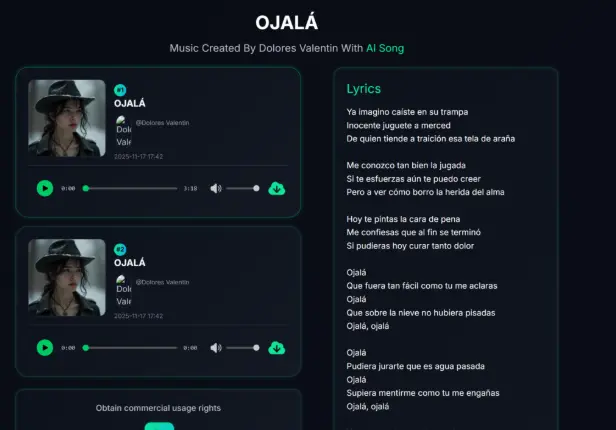
I recently spent some time testing the AI Lyrics into Song engine, and while the technology is still evolving, my experience suggests we are looking at a fundamental change in how music is prototyped, produced, and owned.
Beyond “Robotic” Vocals: The Search for Emotional Resonance
If you played with early AI voice tools a few years ago, you probably remember them being stiff, monochromatic, and frankly, a bit soulless. They could read words, but they couldn’t feel them.
However, the latest iteration of generative audio feels different. In my recent tests with the platform, I noticed that the engine isn’t just looking at the phonetics of the words; it seems to be analyzing the prosody—the natural rhythm and emotional weight of the language.
When I inputted a set of melancholic lyrics about “rain” and “loss,” the system didn’t just paste a happy pop vocal over it. It defaulted to a minor key. The vocal delivery slowed down. It wasn’t perfect—sometimes the phrasing was a bit unexpected—but the intent was there. It felt like collaborating with a session musician who actually read the lyric sheet before playing a note.
The “Text-First” Philosophy
Most music AI tools ask you to pick a genre first, and then they generate a random instrumental track. The lyrics are often an afterthought.
The approach here is inverted. It is a “Text-First” engine. It prioritizes your words as the structural foundation of the song. The AI builds the instrumentation around your syllable count and rhyme scheme, rather than forcing your words to fit into a pre-made box.
A Walkthrough of the Workflow: From Note App to Spotify
For those who are intimidated by mixing consoles and equalizers, the workflow here is refreshingly linear. It strips away the technical friction, leaving only the creative decision-making.
Here is how the process generally unfolds, based on my time using the tool:
1. The Input Phase (The Soul)
You start with a blank text box. This is where you paste your lyrics.
- My Observation: I found the system handles structure surprisingly well. If you use bracketed tags like [Verse], [Chorus], and [Bridge], the AI uses these as instructions to change the energy level.
- The Helper: If you have a theme but are stuck on a rhyme, there is an integrated lyric assistant. It’s useful for breaking writer’s block, though I found the best results came from tweaking the AI’s suggestions with my own human touch.
2. Defining the Musical Identity (The Body)
Once the words are in, you choose the “clothing” for your song. You select a genre (Pop, Jazz, Rock, Electronic, etc.).
- Nuance: The “Custom” mode allows for more specific prompting. Instead of just “Rock,” you might try “90s Grunge with heavy bass.” The results can vary, but when it hits the mark, it’s genuinely impressive.
3. The Analysis and Generation
This is the “black box” moment. When you hit generate, the algorithms analyze the sentiment and meter of your text.
- What’s happening: It is calculating the tempo based on your syllable density. A wordy verse might trigger a faster, rap-like delivery, while long vowels might trigger a slow, melodic sustain.
4. The Result: Ownership and Commercial Rights
This is perhaps the most critical feature for the modern creator economy. The platform grants Full Commercial Rights to the output.
- Why this matters: In an era where a 3-second sample can get your YouTube video demonetized, owning the master recording of a song you “generated” is a massive asset. You aren’t renting the music; you are creating it.

A Reality Check: Managing Expectations
While I am enthusiastic about the potential here, it is important to ground this in reality. This is not “magic.” It is a tool, and like any tool, it has limitations.
- The “Gacha” Element: AI generation can sometimes feel like a slot machine. You might have to generate the same set of lyrics three or four times to get a result where the melody truly clicks.
- Pronunciation Quirks: Occasionally, the AI might mispronounce a proper noun or place the emphasis on the wrong syllable (e.g., saying “PRO-ject” instead of “pro-JECT”).
- High-Fidelity vs. Studio Master: While the audio quality is generally high (often 44.1kHz), it may not yet replace a $50,000 studio recording with a live orchestra. It is best viewed as a high-end demo or a finished product for social media/content creation, rather than a Billboard Top 40 master.
Comparative Analysis: Where Does It Fit?
To help you understand where this tool sits in the ecosystem, I’ve broken down the differences between traditional production, generic stock music, and the AI Lyrics-to-Song approach.
| Feature | Traditional Studio Production | Stock Music Libraries | AI Song Maker |
| Creative Control | High (Total control) | Low (Pre-made tracks) | Medium-High (Text-driven) |
| Cost | $$$$ (Expensive) | $$ (Subscription fees) | Free to start |
| Time to Result | Weeks or Months | Hours of searching | Minutes |
| Lyrical Customization | 100% Custom | None (Instrumental mostly) | 100% Custom |
| Copyright/Ownership | Complex (Splits/Royalties) | Leased (Non-exclusive) | Full Commercial Ownership |
| Skill Requirement | Expert (Theory/Mixing) | None | Basic (Writing/Curating) |
Who Is This Actually For?
After testing the capabilities, I believe three specific groups stand to gain the most from this technology.
1. The “Bedroom” Poet & Storyteller
If you have notebooks full of poetry, this is your translation engine. It allows you to finally hear the emotional dimension of your words. It validates your writing by giving it a form that can be shared and experienced by others, not just read.
2. The Content Creator (YouTuber/Streamer)
Stop fighting with copyright claims. By writing a simple jingle or a theme song relevant to your channel and generating it yourself, you create a sonic brand identity that is legally safe and uniquely yours.
3. The Educator and Parent
Memory is linked to melody. I’ve seen teachers use this to turn dry historical facts into catchy pop songs. If you need to help a child memorize the periodic table, turning it into a song is infinitely more effective than rote memorization.
The Verdict: A New Instrument for a New Era
We are living through a democratization of creativity. Photography became accessible to everyone with the smartphone. Graphic design became accessible with drag-and-drop tools. Now, music composition is becoming accessible to those who can write.
AI Song is not here to replace the human musician. Nothing can replace the sweat and energy of a live performance. But for the writer—the person with the idea but without the instrument—it is a revelation
It invites you to stop letting your best ideas die in the “Notes” app. It invites you to become a collaborator with the machine.
So, here is my suggestion: Go find that poem you wrote years ago. The one you were proud of. Paste it into the engine, pick a style you never considered, and hit generate. You might be surprised by the song that has been hiding inside your words all along.
Also Read-Counterattacking-Based Premier League Betting Techniques