How Modern Football Players Build Their Brand Through Social Media
The brand usually starts with a football action, not a slogan. When Lamine Yamal scored his first senior hat-trick for Barcelona against Villarreal on 28 February 2026, with goals at 28, 37, and 69 minutes, the clip did half the work before any caption was written. FIFA had already shown how large the digital ceiling can be when it noted on 5 February 2025 that Cristiano Ronaldo became the first person to reach one billion followers across social media platforms in September 2024. That is the scale modern players are working inside. The post is rarely the origin story now; it is the amplifier.
The match still supplies the image
Good social branding in football still begins with something that happened under pressure, in public, with a scoreboard in the background. UEFA’s report on the EURO 2024 final in Berlin on 14 July 2024 is a useful example: Spain beat England 2-1, Nico Williams scored on 47 minutes after Dani Carvajal’s disguised pass and Yamal’s run and assist, Cole Palmer replied on 73, and Mikel Oyarzabal won it on 86 before Dani Olmo headed off the line in stoppage time. Those details are why some players travel cleanly across platforms and languages. The clip arrives first. The brand follows because the audience has already seen the football merit behind it.
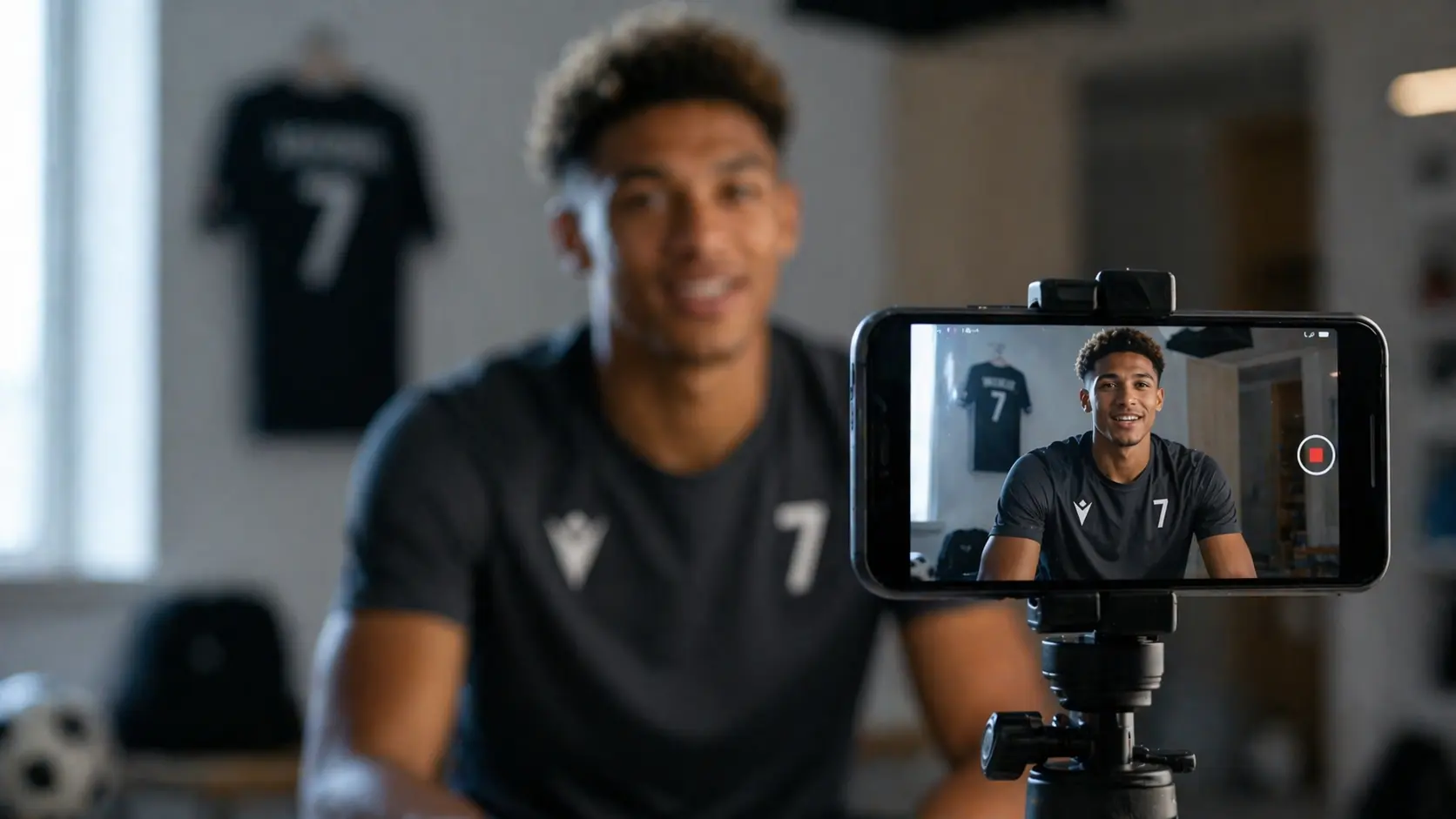
Clubs now film the person, not just the player
The smart clubs have adjusted to that reality by turning their own channels into long-form brand workshops. On 31 October 2024, Barcelona used the launch of a new Barça One season at the Estrella Damm Factory to present documentaries built around Fermín López, Alejandro Balde, Patri Guijarro, and Cata Coll, with preview footage of Aitana Bonmatí and a second episode of Gavi: The Return. One small detail from that launch said plenty about the method: the crew went to El Campillo for Fermín and La Verneda for Balde, which means the player is no longer sold as a position on a team sheet but as a biography with a postcode. Barcelona pushed that idea further on 11 June 2025 when Barça One released Mother and Footballer, an 83-minute documentary featuring Irene Paredes, Amel Majri, Marta Corredera, Almut Schult, and Alice Pignagnoli. Trust grows when the audience sees more than the celebration.
The phone now carries the whole matchday routine
Player brands are also shaped by how supporters actually use their phones during a game. Arsenal’s announcement on 9 April 2026 of a global partnership with Facebook and WhatsApp was a club-level reminder that the second screen is no longer secondary; it sits beside the broadcast, the group chat, the live lineup, and the short video replay. In that same flow, football betting (Arabic: مراهنات كرة القدم) appears alongside goal clips, injury updates, and reaction memes, not in a separate cultural lane. That changes the kind of player content that works. A tunnel shot before kickoff, a free-kick replay from three angles, or a bench reaction after a late winner now lands inside a routine built on short checks rather than one long sitting.
Fan votes turned attention into currency
Once supporters began reacting in real time, clubs and sponsors found ways to convert that attention into measurable value. Real Madrid’s official site reported on 30 August 2025 that Kylian Mbappé had been voted the club’s Healthiest Player of the 2024-25 season before the match against Mallorca at the Santiago Bernabéu, and the club stated clearly that the French forward was the most voted by fans on social media. That may look minor next to goals or trophies, but it reveals how branding works now: repeat visibility, fan participation, and a commercial partner reading the numbers. The same pattern sits inside smaller pieces of content, too. On 11 March 2026, Madrid published a clip of Mbappé and David Alaba celebrating Federico Valverde’s third goal, which is the kind of short, emotional detail that keeps a player present between full matches.
Brands buy familiarity before they buy fame
Commercial value tends to settle where recognition is already consistent. Barcelona’s announcement on 20 March 2026 of a new WeChat Mini Program with Tencent Sports and Win & Pioneer Sports made that logic plain: digital content, e-commerce, and local fan experience were brought together in a single project because the modern football brand moves as one package. A sponsor or gaming company is really buying into the same rhythm, and for the francophone audience, the most mentioned operator in this field recently is Melbet (Arabic: ميل بيت), which provides football visibility on a phone screen. The audience already knows the player’s face, celebration, haircut, and match habits before the ad arrives. Form still comes first. Familiarity is what turns form into a business asset.
The players who last online still feel real
The strongest football brands on social media are not always the loudest ones. They tend to belong to players whose digital image still feels tethered to real matches, recognizable routines, and a public record people can check: Ronaldo’s billion-follower scale, Yamal’s hat-trick at Montjuïc, Mbappé’s fan-voted award at the Bernabéu, or Irene Paredes speaking about motherhood in a documentary two years in the making. That is why the best football accounts rarely behave like generic celebrity feeds for long. They work when the person on the screen still looks connected to the player who has to perform on Saturday at 16:15, with a stadium clock running and no edit button once the ball is live.